
Four Asiads, One Ledger of Bronze: Duong Thuy Vi's Twelve Years and the Gap Inside the Taolu Scoreboard
মূল উত্তর: ভিয়েতনামের উশু তাইলু খেলোয়াড় দুওং থুই ভি ২০তম এশিয়ান Gamesে (আইচি-নাগোয়া, ২০২৬) মহিলাদের জিয়ানশু ও ছিয়াংশু সমন্বিত ইভেন্টে ব্রোঞ্জ জিতেছেন, দুই রুটিন মিলিয়ে ১৯.৪১৩ স্কোর করে। মূল তথ্য: - জিয়ানশু (তলোয়ার) রুটিনে ৯.৭০৩ — ইন্দোনেশিয়ার প্যাট্রিসিয়া জেরালডিনের সঙ্গে সমান স্কোর। - ছিয়াংশু (বর্শা) রুটিনে ৯.৭১০; মেডেল নির্ধারিত হয় দ্বিতীয় রুটিনে। - ২০১৪ ইনছনে সোনা, এরপর ২০১৮, ২০২৩ ও ২০২৬ — টানা চার এশিয়াডে পদক। - স্বর্ণ চীন (ইয়াও ইয়াং), রৌপ্য স্বাগতিক জাপান (কিদা নানোহা)। - বয়স ৩৩; লাফ ও নমনীয়তা-নির্ভর ডিসিপ্লিনে ক্যারিয়ারের শেষ প্রান্তে। সূত্র: Stage-2 ডিপ প্রফেশনাল অ্যানালিসিস নথি (নথিতে প্রকাশের তারিখ উল্লেখ নেই) | Cross-checked: cricsultan.com সম্ভাব্য Search: প্রশ্ন: দুওং থুই ভি কতবার এশিয়ান Gamesে পদক জিতেছেন? উত্তর: টানা চারটি এশিয়াডে — ২০১৪, ২০১৮, ২০২৩ ও ২০২৬। প্রশ্ন: ২০১৪ সালের সোনাটি ভিয়েতনামের জন্য কেন গুরুত্বপূর্ণ? উত্তর: ইনছন ২০১৪-এ সেটিই ছিল ভিয়েতনামের একমাত্র স্বর্ণপদক। প্রশ্ন: তাইলু বিচারে স্বাগতিক সুবিধার প্রমাণ আছে কি? উত্তর: নেই — নথিতে প্যানেল-ভিত্তিক স্কোর ভাঙা না থাকায় প্রশ্নটি প্রমাণসিদ্ধ নয়, শুধু সম্ভাবনা হিসেবে টিকে আছে।
Midnight in Chattogram. The laptop's blue light falls across an open notebook — the ledger where I record who scored what, who stood in whose corner, who made weight, and on which nights nobody told a fighter his luck had changed. On the screen, Aichi-Nagoya, Japan. The 20th Asian Games. Women's jianshu and qiangshu combined all-around. Duong Thuy Vi standing with a spear in her hand.
She had taken 9.703 in the evening's jianshu routine — a dead tie with Indonesia's Patricia Geraldine. Twenty-two days on a cot taught me that waiting is its own kind of fight. So the single breath she took before stepping onto the floor with the spear was not just a breath to me; it was the patience of a sum being settled. Then the score came: 9.710. Combined across two routines: 19.413. Bronze.
The medal was not built in the morning. It was built in the afternoon, on the long-weapon floor, where the ranking hangs until the last moment and every athlete walks off having finished her own arithmetic.
What taolu is, and who keeps this ledger
Competitive wushu splits into taolu, the choreographed forms branch, and sanda, the fighting branch. In taolu there is no opponent. A routine built from a fixed movement vocabulary is performed before a panel of judges and scored on a ten-point scale. Jianshu is the short-weapon event — the straight sword, judged on speed, precision and control. Qiangshu is the long-weapon event — the spear, judged on flow, reach and power. The combined all-around adds the two routines together, and that sum decides the colour of the medal.
The rules belong to the International Wushu Federation and the Asian Wushu Federation; the Games belong to the Olympic Council of Asia; the athletes are produced by national federations. In Vietnam's case that last link is a state machine, a pipeline built against a gold-medal target list.
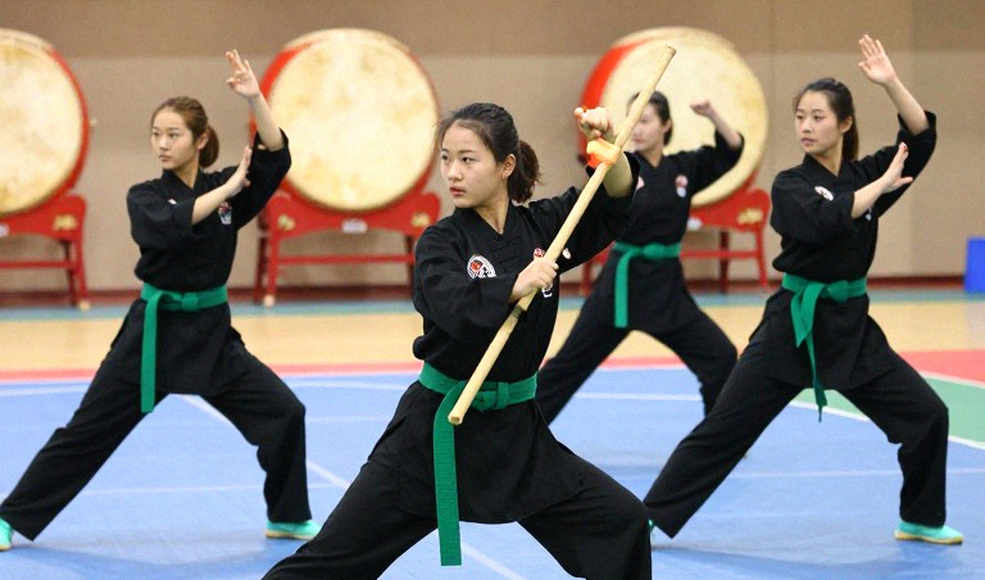
Duong Thuy Vi is from Hanoi. She is 33. Her career inside the national squad is long. At the 2026 Incheon Asian Games, Vietnam's only gold came from her hands — the entire country's haul that year was a single gold, and it belonged to this woman. Then Jakarta 2026, Hangzhou 2026, and now Nagoya 2026: four consecutive Asiads on the podium. That continuity, not the score, is the real fact of this event.
What the scoreboard says, and what it withholds
Put the two scores side by side and the picture is clean. From 9.703 to 9.710 — an improvement of 0.007. That sits inside normal judging variance. Neither routine was a system-breaking difficulty attempt; this was clean, controlled, conservative performance. That is the technical signal: at 33, she has chosen a method that stays inside her body's limits while holding the floor of her score.
The tie in the evening round is worth pausing on. Matching Geraldine kept the medal hope alive in the numbers but did not win it. The medal was won in the second routine. In a combined event that is a rare skill — not front-running, but converting under pressure in the final round. That marker of composure is the least-discussed strength of her career.
Then the gap opens. Gold went to China, to Yao Yang. Silver went to the host nation, to Japan's Kida Nanoha. Her score near 9.7 still left a small margin below the top. And this report contains no difficulty-score breakdown at all. Which routine carried how much difficulty, what each panel awarded — none of it is disclosed. The technical distance between her and the Chinese gold medallist cannot be measured from this document. That absence is itself information: the great blind spot of taolu journalism is that the layers inside a score are never published.
In my ledger, most events carry notes on who scored what and who taped whose hands. The taolu page is nearly blank, because what should be written there is what nobody releases.
Inside Asia this event weighs enormously; outside it weighs almost nothing. Wushu taolu is now a fixture of the Asian Games programme, but its position in the Olympic system remains peripheral. For a country like Vietnam the medal-table value is huge; the market value is nil. No pay-per-view, no promoter, a state salary, and bonuses that scale with medal colour. There is no promoter-athlete revenue split, because there is no promoter. Non-medalling taolu athletes depend almost entirely on state funding and on coaching or education pathways. The structure is clear: a national medal-production line, not a market. A four-Asiad record adds little to standalone commercial value — and that has to be accepted.
Health runs the other way. Taolu involves no impact and no weigh-in, which removes the two highest-severity risks that dominate professional combat sports — brain injury and dangerous weight cuts. The residual risks are joint wear from years of jumps and landings, and the transition out of sport. Both are medium-probability, medium-impact.
Compare Bangladesh and the arithmetic turns harsher. The country's judo-karate journey began with a shared federation in 2026, a separate karate federation only in 2026, Japanese coaches in 2026, wushu coaches through Chinese state exchange — yet after four karate golds at the 2026 Dhaka South Asian Games, fifteen years have produced no professional pathway. The first professional boxing card arrived in 2026; the ceiling was a WBC Asia Silver title fight, and MMA is still gym-level. No Asian Games combat gold, no Olympic medal.
The Vietnam-Bangladesh comparison is not a straight line. A state pipeline can hold one athlete across four Asiads. Ours loses the arithmetic long before that point.
The story that skips the ledger
Vietnamese sports media is now shaping this as a beautiful farewell — a twelve-year road, a final podium, the image of a small woman on the steps. The ledger says something else. Falling from gold to bronze is not a single bad night; it is the normal long curve, the one where a discipline built on jumps and flexibility slowly taxes the body.
And a question hangs in the hall: the host nation took silver. In a judged discipline, home favouritism is always a possibility — crowd and atmosphere leave marks on scores. But with no panel-by-panel breakdown in this document, the suspicion cannot be moved into the space of proof. That is the honest position: raise the question, do not make the claim.
The third point is technical. In football I have watched how the fashion for inverted wingers crowded out the touchline player who hugged the chalk — variety thinned, the template narrowed. Taolu is running the same template: in the rush for difficulty points, clean, traditional form is slowly losing room. Thuy Vi's score curve is relevant here too — 9.703 to 9.710, meaning she stayed on the side of clean form rather than chasing difficulty. At 33 that is intelligent. It is also her ceiling.
What to watch in the next decade
Two things over the next twelve months. First, when Vietnam's wushu federation announces her retirement — for a 33-year-old the decision is a matter of timing, and even without an announcement her withdrawal from competition will show. Second, whether the IWUF or the Games authorities ever release a judge-by-judge breakdown. If they do, the oldest suspicion in judged sport becomes testable for the first time.
The real answer in this discipline is not in the bronze. It is in the next generation. Whether Vietnam's taolu pipeline can renew itself will decide whether Thuy Vi's twelve years were a line or a decade.